
From "The Wonderful Mirror"
3. Mirror of the Sea – 1972, near Izmir
Swimming is not like walking.
The water supports your body and then, at night, it's easy to have dreams in which you fly lightly, just as you flew during the day in the sea, where there is the low point of diving and the high point of rising.
In the sea, I found shells that made sounds, smooth colored stones, and I also understood why it is not worth being afraid.
When I dive, the surface of the water, viewed from below, appears like a constantly moving mirror that does not reflect distinct images. It looks like a luminous barrier marking the boundary with everything above the sea. A reflection that prevents you from seeing the sky, the coast, and the tree-covered hills.
Hyperventilation means breathing deeply and rapidly, to oxygenate the blood and increase your lung capacity. I continue until I feel slightly dizzy: this is the sign that I am ready to dive. Then I do a somersault and descend into the bubbles.
I descend along a wall of broken rocks covered with long, irregular streaks to explore a crevice that runs downwards, just above a flat, stony bottom.
Under the ridge, in the shadows, there is a fish with silver reflections.
It looks at me, turns away, swims off slowly, without apparent emotion, taking advantage of the shelter of a rock frame and continuing to keep an eye on me.
I follow it slowly, trying to approach cautiously so as not to scare it too much: in a race, it is certainly better than me.
Is it me who wants to overwhelm it, or is it a genetic memory, fossilized but alive, that drives me at this moment?
The fish continues to swim downward, still along a sloping crevice, and I follow behind, beginning to feel the urge to breathe again.
Sometimes it happens, especially with large, experienced fish like this one: they sense my body stiffen, my nerves tense up before I pull the trigger, and they anticipate me with a sudden dart.
The fish darts away and hides in a cave. I memorize the landmarks for my next attempt and begin to climb toward the light coming from above.
Now my lungs are crying out for air and I try to calm them down, promising that they will be able to breathe soon, that we will be out in five meters, in three, in a moment.
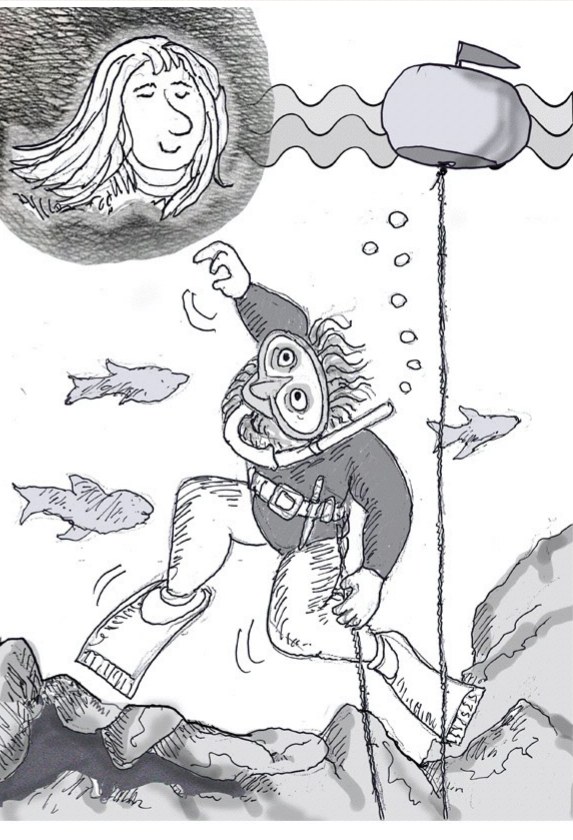
I feel a tremor transmitted to my belt by the rope rubbing against the rock, then an elastic tug and the ascent stops.
A long rope is attached to the lead-weighted belt, as required by law, and a balloon is attached to the rope to signal my presence to those sailing on the surface.
I look down and see the rope anchored to a rock hook: a sort of double rope with me on one side, the balloon on the other, and the submerged hook in between.
It's like being suspended, but in a symmetrical situation, because instead of supporting me, the rope is holding me back.
A sharp tug, an attempt to pull on the fins: the line doesn't give way, the balloon doesn't sink underwater, and time stands still.
The moment expands and my thoughts follow different paths, searching for a way out of this situation, unable to stop thinking. They are images, impulses to act and quick counterorders, rough plans but also words.
I mustn't keep struggling and forcing it even more. No! Danger!
The first attempt was already too tiring and the rope didn't give way at all. Calm down!
Take out the knife to cut the line? That's impossible!
It's not sharp enough!
Dive back in and pass under the rock in the opposite direction to free it? Impossible! I don't have enough strength left!
So that's how it happens. Without fanfare, without any special rituals. Without warning. Without fear or anguish, with quiet sympathy for the people I have known and the world I am leaving behind. That's how the end of the line is.
And then?
Better to hold out a little longer: when you run out of oxygen, you pass out, and that's not as annoying as drinking and coughing.
How much I love Bella!
Yet I cannot return to her in the world where you can breathe air, and I know this will upset her.
I don't want to disappoint her! I don't want to! So what now?
A new attempt, without detachment, without scientific curiosity, with tense will, with urgency, not for me but for her.
Suddenly, the solution appears in the form of a simple gesture. Of course! Easy!
Why didn't I think of that right away? Is there still time?
My hands rush to open the snap buckle of the belt, which slowly descends to the bottom, with its lead weights, its knife, its line attached to the balloon, leaving me free, while I try not to open my mouth and not to try to breathe too soon.
Now I have to go back up, break through the mirrored ceiling, come out for the longest breath of all, followed by many others, until my heart calms down.
Then remember that that empty thing I got very close to is not scary; if anything, it's a little intriguing.