
Autobiography of
Cristina Làstrego Testa
from "The Wonderful Mirror"
One day I saw that Bella was writing. Curious, I asked her what it was about.
— I didn't draw today! I felt like writing a piece of my story too! Look!
She handed me a notebook with several pages neatly written in her clear architect's handwriting.
I found them interesting and asked her if she could include them among the pages of this book.
She thought it was amusing and agreed.
So here is a fragment reproduced below.
When someone writes their autobiography, don't they reveal themselves in the selection of memories that rise to the surface, choosing only the ones they want to tell?
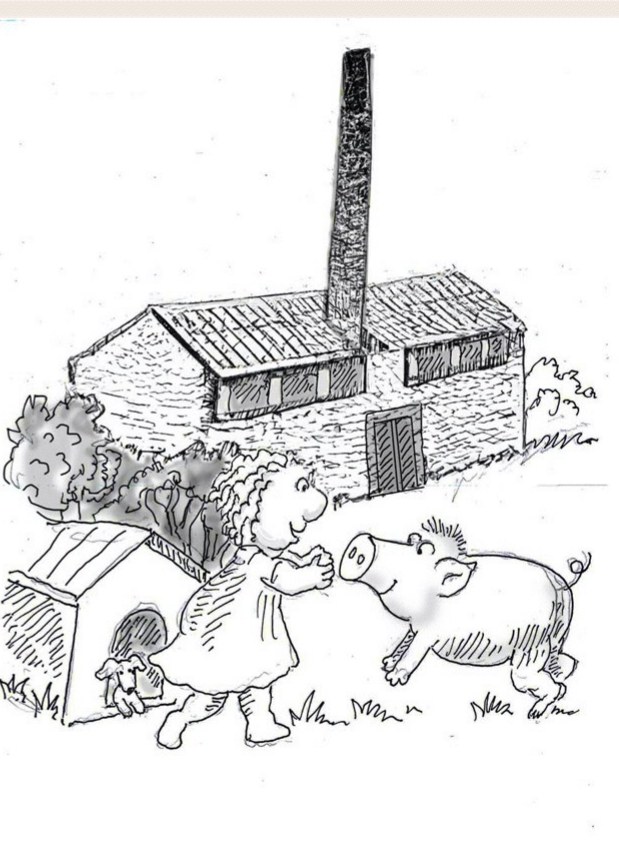
I was born in Italy, in Castello d'Annone, near Asti, in my grandfather's brick kiln.
From a very early age I loved playing with clay and raw bricks, which I used to build constructions of many different shapes.
There was a little pig called Rilli, and I could communicate with him by making small grunts.
I had small scissors and used them to cut out long rows of paper dolls holding hands, and adults were amazed by my manual ability.
I took possession of my grandfather's old account books, whose numbers had become useless with time, and I drew all the farm animals I saw around me.
When I was five years old, I left for Argentina with my parents to join an uncle who was a sculptor and had had to flee Italy years earlier because he had bravely spoken out and been persecuted by the fascists.
My life in Buenos Aires changed completely: from the countryside I had moved to a big metropolis that impressed me with its size and whose cultural liveliness I would later appreciate.
Comic strips had an important place in the Buenos Aires newspapers.
When I lived there as a young girl, there was also Héctor Oesterheld, who wrote the story of Ernie Pike, Hugo Pratt, who drew it, and then Mordillo, Quino, Oski…
My dad had built me a rudimentary machine for projecting images, and I would draw comic strips on transparent paper and then organize shows with my friends…
In high school, I met an extraordinary teacher: my psychology teacher.
She was young. She acted like a friend and taught us how to use some of our abilities. In particular, she had us experiment with telepathic transmission of numbers. Taking note of the results, it was clear that some of us were better at transmitting and others at receiving.
I was pretty good at receiving.
There was nothing mysterious about it: rather, it was an interesting game and the discovery of possibilities that others had never told me about.
It was a happy and peaceful experience, a way of receiving some of the instructions for using a life that had just begun.
After high school, I really wanted to go to school to become a cartoonist. But when it came time to choose, my old passion for construction prevailed, and I enrolled in architecture.
I studied for four years in Buenos Aires, while teaching elementary school children as a substitute teacher.
On my way back to Italy, I stopped in Barcelona to see Gaudí's buildings and fell in love with Park Güell, partly because of the collages of broken tiles and the crooked brick arches.
I finished my architecture studies in Turin, where I met a strange group of students.
In particular, there was one who studied philosophy, wore an old black loden coat, and had a slouch hat with a hole in the top, like the one a bullet might have made.
His name was Francesco.
We exchanged comic drawings and even a few kisses.
During that period, we visited the Bologna Children's Book Fair, and fate decided for us in the form of an editorial manager who, seeing us standing in front of his stand, came out, welcomed us, and, after looking at our drawings, offered us the chance to make a book. We didn't think too much about the nature of this very unusual event, which has never happened again in our lives, and we accepted.
We wanted to be together, collaborating on the same activity. We liked drawing. We liked having an audience of children and meeting them at school and in public libraries.
We started working in publishing and have continued to do so for many years since then.
We have written and illustrated more than 180 books, our works have been translated in about twenty countries, always pursuing a dream: that of offering fantastic stories, but also ways of thinking and understanding life and the world freely.
Then came CD-ROMs, which struck us as the first truly interactive offering aimed at children. We have published 12 of them.
Then, in my later years, I developed a new passion for animation, and we created around 250 episodes featuring various characters, mainly in co-production with Rai, which were broadcast in many countries.
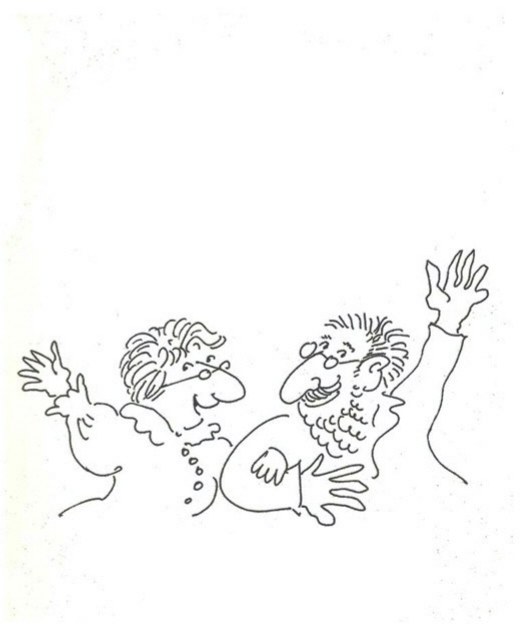
All this was interesting but also demanding.
One night, I couldn't sleep and was looking for something to do. I picked up some broken computer parts, unusable scraps produced during my work in the field of animation.
Their appearance fascinated me, and I began to put them together, forming happy, life-loving characters where before there were only scattered pieces that had reached the end of their useful life.
So I discovered a way of working and a freedom that was different from what I knew when making books or animated drawings.
From then on, I continued to see everyday objects in an unusual way and used them for recycling: fabric scraps, lace, buttons, and trimmings became my palette.
Even old coffee pots, found in a cupboard, inspired me to give them new life, and I enjoyed doing so, transforming them into characters, each with its own personality.
It is true that the whole is something different from the parts that compose it and that a new work grows in continuous dialogue between what is imagined and the reality that gradually takes shape.
For those who look at the fantastic characters I create at night in my workshop, the choice remains open between accepting the smiling message that each of them wants to convey or playing at recognizing the individual elements of which they are made.